
Expert Support
Available 24/7 via chat
Available 24/7 via chat

Last Updated: August 29, 2026
Counterfeit perfumes represent a $3.14 billion global problem accelerating rapidly. The market jumped from $2.71 billion in 2024 to $3.14 billion by 2025, with projections reaching $13.61 billion by 2035 at a 15.80% compound annual growth rate, according to Scento's 2026 counterfeit perfume statistics. Counterfeits now represent 28% of global perfume sales, and brands lose up to 20% of potential revenue to counterfeit listings on online platforms alone.
The health stakes are severe. Counterfeit perfumes contain toxic substances, methanol, heavy metals (lead, mercury, cadmium, arsenic), endocrine disruptors (phthalates, parabens), and biological contaminants including E. coli. These cause chemical burns, neurological damage, organ failure, skin infections, and respiratory distress. This guide from AppleMango Fragrances walks you through how to identify fake designer perfume before it reaches your skin.
Authentic designer perfume boxes follow rigid standards that fakes struggle to replicate. Start here because packaging flaws are often visible before you open the box.
Authentic boxes use sturdy cardstock with substantial weight and structural integrity. The printing should be crisp and perfectly flush with no raised edges, misalignment, or bleeding ink. Typography is where counterfeits consistently fail: examine fonts for sharpness, consistency, and perfect spacing. Check the brand logo for flawless rendering with consistent line weight and color saturation. Counterfeit logos often appear fuzzy or have inconsistent color density.
Color reproduction matters significantly. Authentic boxes use premium printing that produces vibrant, saturated colors. Counterfeits often have dull or off-tone colors from cheaper printing methods. Compare the box color to the brand's official website, the hue should match exactly.
Authentic designer perfume arrives wrapped in cellophane applied with precision machinery. The wrapping should be tight, smooth, and completely flawless with no wrinkles, creases, or loose edges. Seams should be invisible or nearly invisible, machine-sealed with perfection.
Real wrapping feels uniform and smooth. Counterfeit wrapping often has inconsistent tension, visible seams, or wrinkles suggesting manual application. The cellophane should be crystal clear with no yellowing or cloudiness.
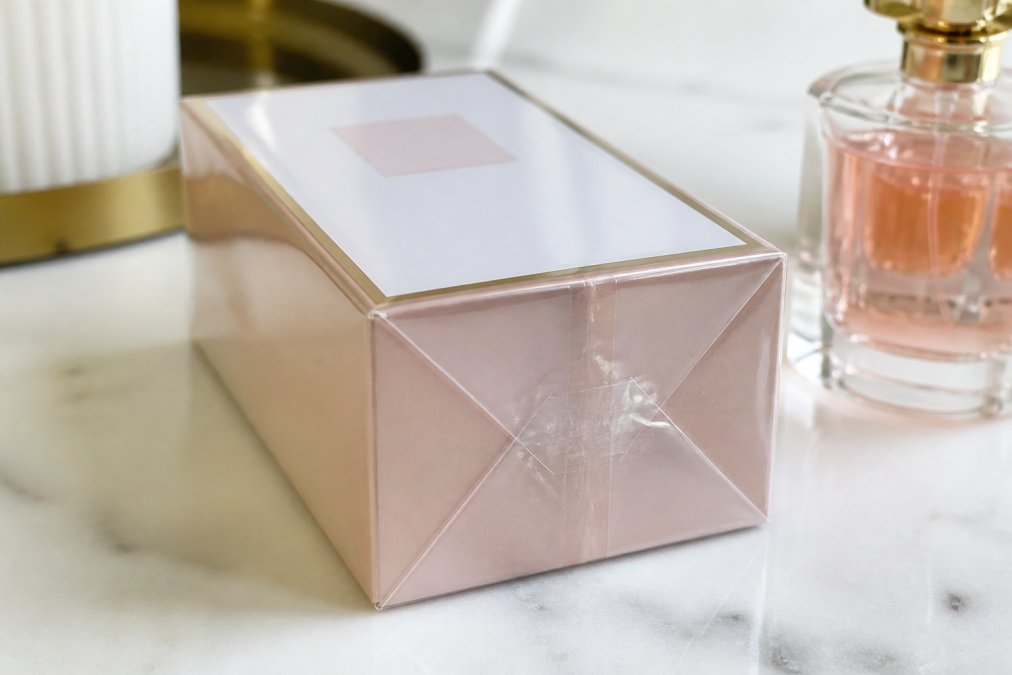
Check the barcode placement and print quality. On authentic boxes, the barcode should be perfectly printed with clean, sharp lines and should match the batch code printed elsewhere on the box, a critical verification point counterfeiters often overlook.
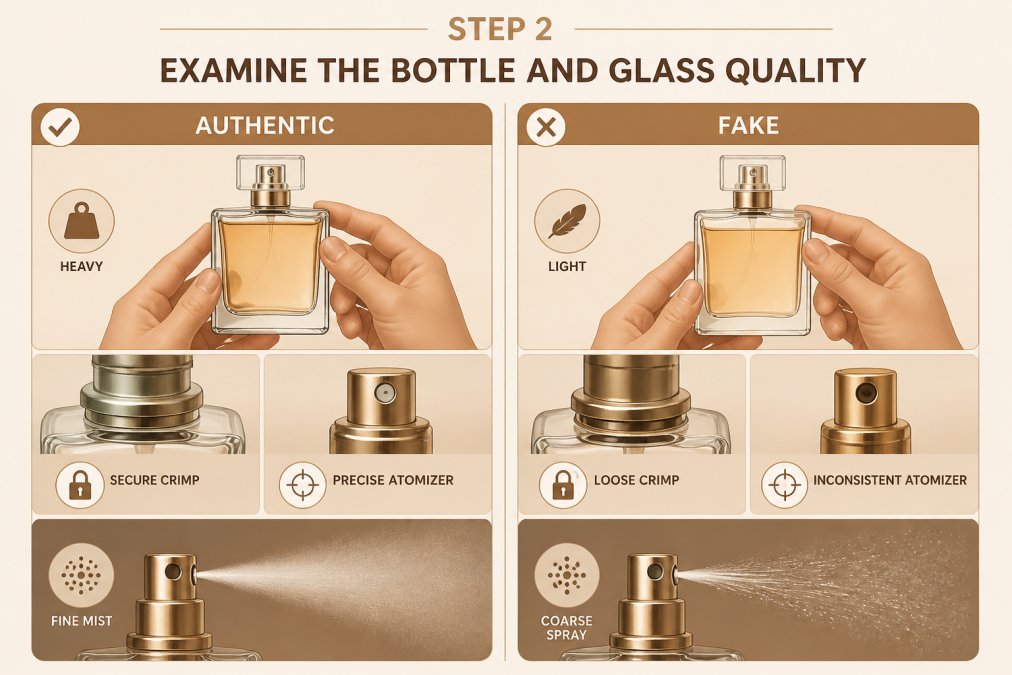
The bottle reveals authenticity through weight, clarity, and construction precision. Luxury fragrances use premium glass that's noticeably heavier than standard bottles, communicating quality and justifying the price point.
An authentic designer perfume bottle should feel substantial and well-balanced. The glass should be perfectly clear with no cloudiness, sediment, or discoloration. Hold it to light, you should see completely transparent liquid with consistent color throughout. Any haziness, particles, or uneven coloring indicates a counterfeit.
The glass surface should be smooth and flawless. Seams where the bottle was molded should be nearly imperceptible on authentic bottles. Counterfeits often have visible seams, rough edges, or manufacturing defects. The base should be precise and clean with no rough spots or air bubbles, and should sit flat and stable.
The cap should fit perfectly without excessive looseness or force. The crimp (metal band holding the atomizer) should be uniformly tight and symmetrical, applied with precision machinery on authentic bottles. Counterfeit crimps are often uneven, loose, or haphazardly applied.
Press the atomizer gently, it should produce a fine, even mist that disperses smoothly. Counterfeit atomizers often produce weak sprays, uneven patterns, or sputtering. The spray mechanism should be smooth and consistent with every pump. Examine the spray button: it should depress smoothly and return with consistent resistance, centered perfectly with no wobbling.
The batch code is your most reliable verification tool. Every legitimate fragrance carries a unique identifier indicating manufacturing date and location. Counterfeiters sometimes include batch codes, but they're rarely correct or verifiable.
Batch codes appear on the box bottom or back, on the bottle itself (usually bottom or back), and sometimes on the outer carton. The code should be identical across all locations. If batch codes don't match between box and bottle, that's a red flag.
The batch code format varies by brand but typically consists of letters and numbers indicating production month, year, and facility. Research your specific brand's batch code format on the official website. On authentic bottles, the code should be cleanly stamped or engraved with sharp, legible characters. Counterfeit codes are often poorly printed, faded, or smudged.
Most luxury fragrance brands offer batch code verification through their official websites or apps. Go to the brand's official site and locate their authentication tool, then enter your batch code exactly as printed. The tool will confirm legitimacy and provide manufacturing details.
AppleMango Fragrances sources exclusively from authorized distributors and can verify the authenticity chain for every fragrance in our collection. If purchasing from a retailer, ask whether they can provide batch code verification. Keep detailed records of your batch code information and screenshot verification results for warranty or return purposes.
Designer fragrances cost what they cost for a reason: premium ingredients, research, packaging, and brand value. Suspiciously low prices usually indicate counterfeits, not bargains. Legitimate retailers maintain consistent pricing within a reasonable range. Massive markdowns (50%+ off retail) are warning signs, as brands protect pricing to maintain luxury positioning.
Verify retailer legitimacy by checking whether they're listed as authorized distributors on the brand's official website. Read customer reviews on independent platforms. Online marketplaces are particularly risky, in October 2021, researchers identified 20,280 active counterfeit sellers on Instagram collectively reaching over 10 million users. Buying from individual social media sellers is substantially riskier than purchasing from established retailers.
Check the seller's return policy. Legitimate retailers offer clear return policies and stand behind their products. If a seller refuses returns or has vague policies, that's suspicious. Authorized retailers welcome verification because they know their products are authentic.
The fragrance itself reveals authenticity. Real perfumes have complexity and evolution. Counterfeits often smell flat, synthetic, or off because they lack the rare, high-grade ingredients that create authentic scent profiles.
Authentic fragrances open with bright, volatile top notes that fade over 5-15 minutes. As top notes dissipate, heart notes emerge as the main character. Finally, base notes anchor the scent, providing longevity and depth.
Apply the fragrance to pulse points (wrist, neck, behind ears) and observe progression. In the first 5 minutes, notice the top notes, typically citrus, herbs, or fresh florals. After 15-30 minutes, heart notes should emerge. Base notes should be noticeable after 1-2 hours.
Counterfeit perfumes often lack this complexity, smelling one-dimensional, synthetic, or overly chemical. They might be strong initially but fade rapidly or smell harsh. Real fragrances have smoothness and sophistication that cheap synthetics cannot replicate. Research the authentic fragrance's scent profile before testing to know what top, heart, and base notes should be.
Sillage is the scent trail you leave. Authentic designer fragrances typically have excellent sillage, you should smell yourself throughout the day without reapplying. Counterfeit fragrances often have weak sillage or fade within 2-3 hours. Authentic fragrances should last 6-8 hours or longer.
The dry down, how the fragrance smells after several hours, is particularly revealing. Real fragrances maintain their character and smell pleasant throughout the day. Counterfeits sometimes smell unpleasant or unrecognizable after a few hours because cheap ingredients break down differently than premium ones.
Counterfeit perfumes pose serious health risks. Chemical analysis using GC-MS found that original samples contained 45 distinct compounds, while counterfeit samples contained only four: linalool, citronellol, methyl jasmonate, acetic acid, and propanol. Linalool concentration in counterfeits was as low as 5.1% of authentic amounts. Counterfeits substitute expensive synthetics with cheap fillers like Dipropylene Glycol and hazardous compounds including methanol.
Authentic fragrances use rare, high-grade synthetics like Cashmeran and Ambrox, ingredients that cost significantly more but create the signature scent profile. Counterfeit fragrances are often manufactured in uncontrolled environments with no safety oversight, resulting in contamination with heavy metals, bacteria, and toxic chemicals.
Fake perfumes have caused chemical burns, severe skin rashes, neurological damage, and allergic reactions. Some contain DEHP (diethyl phthalate), a probable human carcinogen. Phthalates and parabens function as endocrine disruptors, interfering with hormone regulation. Heavy metals like lead, mercury, cadmium, and arsenic accumulate in the body and cause neurological damage and organ failure. If you experience chemical burns, severe rashes, breathing difficulty, or neurological symptoms after using a fragrance, seek medical attention immediately and report the product to the FDA.
Not all non-authorized fragrances are counterfeits. Gray-market fragrances are authentic products manufactured by the brand but sold through unauthorized distributors. These might be overstock, discontinued products, or fragrances purchased from one region and resold in another. Gray-market goods are real but bypass the brand's official distribution network.
Counterfeit fragrances are fake products manufactured illegally without the brand's involvement. They're designed to deceive consumers and contain inferior or dangerous ingredients with no quality guarantee.
Gray-market goods pass all authentication tests: batch codes verify correctly, packaging is flawless, glass quality is excellent, and scent profiles are authentic. The only difference is the retailer isn't authorized. Counterfeits fail multiple checks: batch codes don't verify or appear fabricated, packaging has printing errors, glass is thin or cloudy, and the scent is off or synthetic.
AppleMango Fragrances sources exclusively from authorized distributors, guaranteeing 100% authentic fragrances with full brand backing. We verify every product in our collection and stand behind the authenticity of every fragrance we ship.
| Authentication Check | Authentic | Gray Market | Counterfeit |
|---|---|---|---|
| Batch Code Verification | Passes official verification | Passes official verification | Fails or doesn't verify |
| Packaging Quality | Flawless printing, sturdy construction | Flawless printing, sturdy construction | Printing errors, poor quality |
| Glass Quality | Heavy, clear, smooth | Heavy, clear, smooth | Thin, cloudy, rough |
| Scent Profile | Complex, evolving, lasts 6-8+ hours | Complex, evolving, lasts 6-8+ hours | Flat, synthetic, fades quickly |
| Retailer Authorization | Authorized distributor | Unauthorized but selling real products | Illegal seller |
| Health Safety | Safe, tested ingredients | Safe, tested ingredients | Contains toxic substances |
Identifying fake designer perfume requires attention to detail across multiple verification points. Start with packaging inspection, typography, color saturation, and cellophane wrapping quality reveal counterfeits immediately. Examine the bottle: weight, glass clarity, and atomizer precision tell you whether you're holding a premium product or a cheap fake. Verify the batch code through the brand's official authentication tool. Test the scent profile and longevity, authentic fragrances evolve beautifully over hours, while counterfeits smell flat and fade quickly.
Counterfeit perfumes contain toxic chemicals and biological contaminants that cause serious health problems. When you purchase designer fragrances, verify authenticity before applying them to your skin. AppleMango Fragrances eliminates this risk entirely. Every fragrance in our collection is sourced directly from authorized distributors and verified for authenticity. We stand behind every product we ship, offering fast U.S. delivery and complete confidence in what you're purchasing.
Most luxury brands offer batch code verification on their official websites or through third-party tools. Locate the batch code on both the box and bottle, they must match exactly. Enter the code into the brand's authentication system or use independent perfume batch code checker tools. The code should be cleanly stamped or engraved, not printed. If the batch code is missing, mismatched, or appears smudged, this is a red flag for counterfeits. Keep in mind that while batch codes help verify legitimacy, they alone don't guarantee authenticity, combine this check with packaging and scent analysis.
Counterfeit perfumes often contain hazardous substances including methanol, heavy metals (lead, mercury, cadmium), phthalates, and biological contaminants like E. coli. These can cause chemical burns, skin rashes, respiratory distress, and even neurological damage with prolonged exposure. The dangers of counterfeit perfume extend beyond immediate reactions, some contain probable carcinogens like DEHP. Unregulated manufacturing processes mean no quality control, so you may unknowingly apply toxic compounds directly to your skin. Always purchase from authorized retailers to avoid these serious health risks.
Yes, absolutely. Counterfeiters have become increasingly sophisticated at replicating packaging, typography, and even batch codes. A convincing box doesn't guarantee the fragrance inside is authentic. This is why examining multiple factors, bottle weight, glass quality, spray mechanism, scent longevity, and chemical composition, is essential. Some counterfeits pass basic visual inspection but fail when you test the actual fragrance. The scent may fade within minutes, smell synthetic or off, or lack the proper top notes and dry down profile. Always combine packaging inspection with scent testing and batch code verification for the most reliable authentication.
Request detailed photos from the seller showing the box, cellophane wrapping, batch code location, and bottle. Look for crisp, saturated printing with consistent fonts and no spelling errors. The cellophane should be tight and flawless with no wrinkles or loose edges. Check that the batch code is present on both box and bottle and appears cleanly stamped, not printed. Ask the retailer about their sourcing, authorized distributors should provide documentation. Buy only from established, authorized retailers with verified customer reviews. If something feels off about the listing, photos, or seller's credibility, move on to a trusted source.
{"one"=>"Select 2 or 3 items to compare", "other"=>"{{ count }} of 3 items selected"}