
Expert Support
Available 24/7 via chat
Available 24/7 via chat

Last Updated: September 20, 2026
Perfume batch codes are short strings of letters and numbers stamped on a fragrance to record when and where it was produced, the fastest way to learn a bottle's true age before you buy.
Here is the part most shoppers get wrong: a batch code tells you the manufacturing date, not whether the bottle is real. Counterfeiters copy valid codes onto fake packaging, so a code that checks out proves only that someone printed it. This guide from AppleMango Fragrances walks through identifying perfume batch codes step by step, from locating the stamp to reading the date and judging what the result means.
Batch codes matter because fragrance changes with time. Light and heat break down the chemicals inside the bottle, fading top notes and dulling base notes. A bottle made five years ago and stored badly smells nothing like a fresh one, so knowing the production date helps you avoid paying full price for old stock.
A barcode identifies the product line and is identical on every bottle of a given fragrance worldwide. Scan it, and you get the brand, name, and size.
A batch code identifies the production run. It changes with each manufacturing lot, so two identical bottles can carry different codes.
| Feature | Barcode | Batch Code |
|---|---|---|
| Purpose | Identifies the product | Identifies the production run |
| Same on every bottle? | Yes | No |
| Typical format | 12-13 digits | 3-10 letters and numbers |
| Tells you the age? | No | Yes, once decoded |
The practical takeaway: use the barcode to confirm what the product is, and the batch code to find out when it was made.
Start with the base of the bottle. Turn it upside down and look at the glass or the sticker under it. Most brands stamp the code there.
If you do not find it on the bottle, check these spots:
Codes are small, often 4-6 characters, and printed in a color that blends with the surface. Tilt the bottle toward a light source. The stamp usually catches the glare before the glass does.
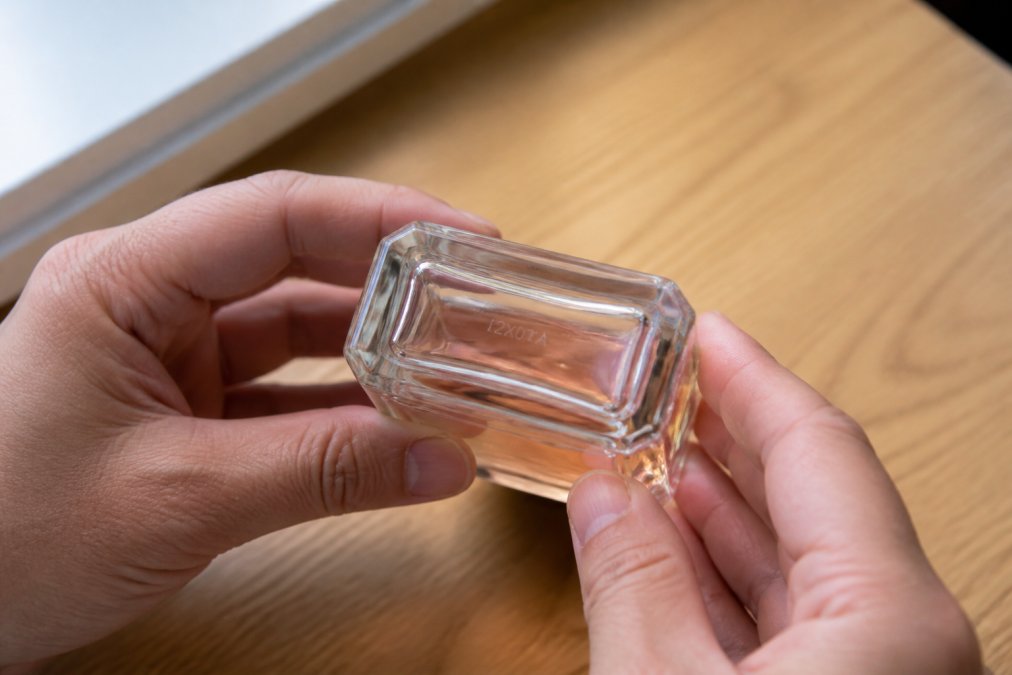
Etched codes are cut into the glass. Run a fingernail across one and you feel a slight groove. They do not rub off and are hard for counterfeiters to copy cleanly.
Printed codes sit on top of the surface as ink or a sticker and can smudge, fade, or peel. A printed code is not automatically a red flag, plenty of legitimate brands use ink, but one that wipes away with a thumb is worth a second look.
A common mistake is checking only the box and skipping the bottle. Boxes get swapped. The bottle is the harder item to fake.
Decoding a batch code means matching the brand's own format to a production date. There is no universal system, so the brand name is the key you need first.
Follow these steps:
Formats vary more than most people expect. Some brands use the first character for the year and the second for the month; others bury the date mid-sequence, and a few use a letter whose alphabet position gives the year.
This is why deciphering by eye fails so often. Two brands can print the identical string "6A01" and mean two completely different production dates.
A perfume batch code checker is an online tool that takes a brand name and code, then returns a production date. Several free options exist, including CheckFresh batch code lookup tool and CheckCosmetic batch code database.
The process takes under a minute:
Most guides stop there. The harder skill is reading the result correctly, because a checker returns a date, not a verdict. Three patterns cause the most confusion.
Reused codes. Some houses recycle the same code string on a rolling cycle, often every ten years. A tool storing only one entry for that string returns the older date and makes a recent bottle look a decade old. If the returned date predates the fragrance's launch, the code was almost certainly reused, cross-check the launch year before trusting the result.
Conflicting results between tools. Databases update on different schedules. When two tools disagree, the newer database is usually right, but not always. Compare each date to the bottle's packaging style and the brand's current label design; a date matching an older label format on a newer-label bottle signals a stale tool, not a bad bottle.
Codes that decode to a future date. This almost always means a transcription error, I and 1, O and 0, and S and 5 are the usual culprits on small stamped codes.
If you are standing in a store or at a counter deciding on a bottle right now, run this sequence on your phone:
Learning how to spot fake designer perfumes comes down to stacking several small signals. No single check is conclusive, and the batch code is the weakest one on its own.
Look for these red flags:
Batch codes are easy to fake and copy; purchase channel is much harder to fake. Authorized retailers, brand boutiques, and established sellers with a return policy carry accountability a marketplace listing does not. If the price is dramatically below the brand's own and the seller has no return policy, the seller, not the batch code, is the deciding factor.
Perfume shelf life is the window in which a fragrance still smells the way the perfumer intended. Most hold up well for three to five years when stored properly, and many last longer. Citrus-forward scents fade faster than heavy orientals because their top notes are the most fragile.
Batch codes are typically found on the bottom of the bottle, either printed or etched into the glass. You may also find a matching code on the outer packaging box. For some brands, the code appears on the back label or along the bottom edge of the box. Always check both the bottle and the box, as a mismatch between the two can indicate tampering or a counterfeit product.
Yes, counterfeiters often copy valid batch codes from authentic packaging and print them on fake bottles. A matching code does not guarantee authenticity. Batch codes indicate production dates rather than serving as definitive proof of product authenticity. Use batch codes as one verification step alongside other checks like packaging quality and retailer reputation.
It depends on storage conditions. Most fragrances have a shelf life of three to five years when stored away from heat, light, and humidity. A seven-year-old perfume kept in a cool, dark place may still be wearable, but top notes often fade first. If the scent smells sharp, sour, or noticeably different from what you remember, oxidation has likely altered the chemical composition. Trust your nose over the calendar.
First, double-check that you entered the code correctly, including any letters and numbers. Some brands use formats that online tools may not cover. If the code still isn't recognized, the brand may have changed its coding system, or the product could be from a limited run. A batch code checker is a helpful tool, but it isn't the final word on authenticity.
{"one"=>"Select 2 or 3 items to compare", "other"=>"{{ count }} of 3 items selected"}