
Expert Support
Available 24/7 via chat
Available 24/7 via chat

Last Updated: September 11, 2026
According to Scento's Gen Z Fragrance Statistics 2026 report, 78% of consumers now start with travel sizes rather than committing to a full bottle. That single number explains why the best ways to sample designer fragrances have shifted from department-store guesswork to a disciplined, at-home testing process. Customers who smell before they buy rarely regret it.
A blind buy is a full bottle bought on a description or recommendation alone, the most expensive mistake in fragrance collecting.
The math is unforgiving. A $120 bottle that doesn't suit your skin chemistry is $120 wasted. A $20 sample set that rules out three wrong choices is $20 well spent.
Below: how to test samples properly, which discovery formats fit your budget, and how to store what you don't use yet.
Testing a perfume sample properly means applying it to clean, moisturized skin, wearing it a full day, and tracking how it changes. Paper alone can't tell you whether a fragrance belongs on your skin.
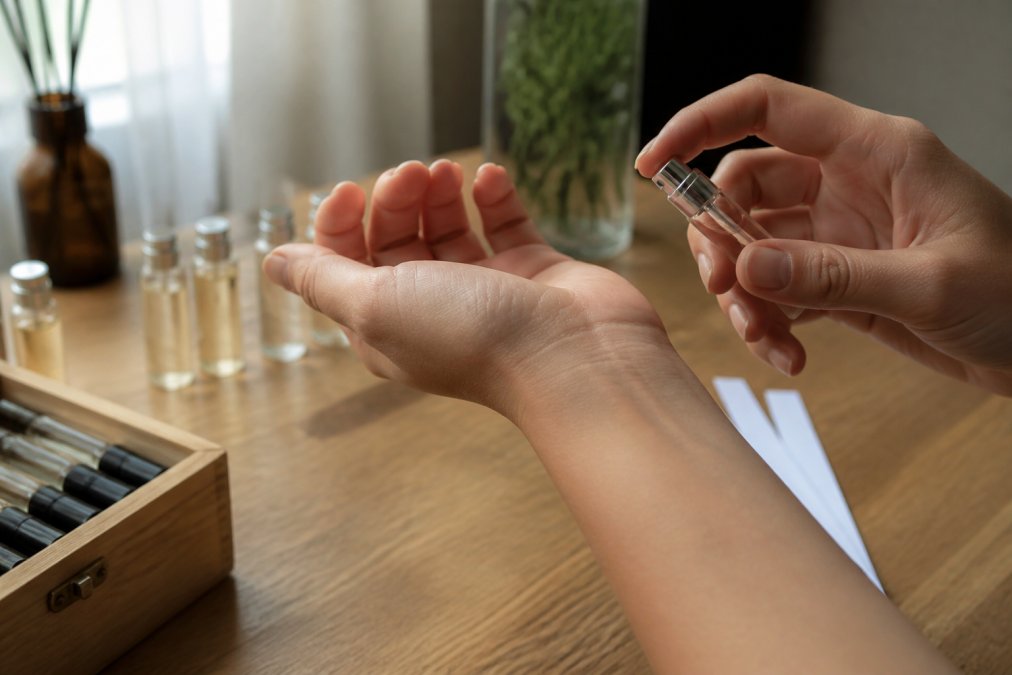
Here's the protocol that works:
That last step matters most. A fragrance's dry down is when base notes take over and the scent settles into what you'll actually smell most of the day.
A blotter (scent strip) is absorbent paper used to screen fragrances without applying them to skin, fast, clean, and excellent for elimination.
What blotters can't do is predict skin chemistry. As The Fragrance Sample Shop's guidance on testing methods notes, paper strips don't replicate how a fragrance interacts with your body over time, which is the whole point of a full-bottle investment.
Use blotters to narrow ten options to three. Use skin to pick the winner.
Apply to pulse points, wrists, inner elbows, throat, behind the ears, where heat amplifies projection. Two sprays is enough for testing; more overwhelms your nose before the fragrance develops.
A fragrance discovery set is a curated collection of small vials or travel sprays from one house, sold at a fraction of full-bottle cost, the fastest way to learn a brand's style without committing. Consider Creed Eau de Parfum Spray 0.33 oz Set of 5 (Women) at $237.07, covering five feminine signatures from radiant florals to rich oud.

Men get the same advantage from Polo by Ralph Lauren 4-Piece Variety Mini Gift Set at $75.82, four 0.5 oz minis spanning the classic green, Polo Black, Polo Blue, and Polo Red.

That's four different scent profiles for less than the cost of one full bottle.
Olfactory fatigue is the temporary loss of your ability to detect a scent after prolonged exposure, why a fragrance you loved at noon seems invisible by 4 p.m.
The fix is spacing, not willpower.
The right format depends on how many scents you want to explore and how much control you want. A decant is fragrance transferred from a full bottle into a smaller atomizer; a vial is the manufacturer's own miniature, usually 0.05 oz or smaller; subscription boxes send a rotating selection on your schedule.

| Format | Typical Size | Best For | Control Level |
|---|---|---|---|
| Manufacturer vial | 0.05 oz | Testing one specific scent | High |
| Decant | 2-10 ml | Trying expensive niche bottles | High |
| Travel spray set | 0.25-0.5 oz each | Learning a whole house | Medium |
| Subscription box | Varies monthly | Broad discovery | Low |
If you know which fragrance you want to test, a single vial is the cheapest path, Garden by Dolce & Gabbana Vial (sample) .05 oz at $23.27 tests one fresh Mediterranean floral before you commit to the full size. To explore broadly, a travel spray set gives more volume per scent and a better sense of how each wears over a full day.
Most sampling guides stop at "keep it in a cool, dark place", correct and almost useless. A 0.05 oz vial holds roughly 1.5 ml, and once opened it loses its most volatile molecules (bright citrus, green aldehydes, airy top notes) before the base notes change at all.
Three forces do the damage, in this order of severity:
Shelf life depends on the composition:
A practical rule: if you haven't reached for a sample in a year, test it against your memory before you trust it. If the opening smells thin, sharp, or like alcohol where it used to smell rich, the top notes are gone.
Sample swapping is one of the cheapest ways to expand what you can test, but a vial that has touched someone else's skin is a hygiene question, not just logistics.
Cost-efficient sampling comes down to knowing which channels give the most fragrance per dollar, and which are free.
Most major designer houses run a sample request or discovery program on their own sites, the single most underused channel:
The fragrance counter is a free testing lab, but most people use it badly. A few habits make it far more productive:
When you do spend money, spend it on the smallest possible unit first.
A monthly subscription box sends a rotating selection on your schedule, great for broad discovery but with almost no control over which scents you test. A decant service lets you pick individual fragrances, so every dollar goes toward something you actually wanted to smell. How to decide:
Decanted samples now start as low as 99¢ from specialized services, according to Befrsh's analysis of fragrance sampling services, which makes exploratory testing genuinely affordable. The market itself reflects that demand: the global perfume market reached $60.0 billion in 2025 and is projected to hit $63.5 billion in 2026, per Grand View Research's perfume market analysis.
As Jessica Kiely of Sensoriam puts it: "One of the best ways to explore new scents is through discovery sets or mini perfume samplers."
The hard part of fragrance shopping isn't finding scents you like. It's knowing which ones will still smell right on your skin eight hours later, and that answer only comes from disciplined sampling. AppleMango Fragrances curates 100% authentic designer, niche, and Middle Eastern fragrances with fast US shipping, so you can test with confidence before you commit. Start with a discovery set, a single vial, or a travel spray, then let your own nose make the final call. Explore the collection and find the scent that actually fits you.
Buy from retailers that source directly from brands or authorized distributors and state that policy on their site. AppleMango Fragrances carries 100% authentic designer and niche vials and sets, such as the Garden by Dolce & Gabbana Vial (sample) .05 oz for $23.27. Avoid unlabeled decants from unknown sellers, and check that the vial arrives sealed with the brand's name and batch code intact.
Spray onto clean, moisturized skin at one pulse point and leave it alone. Do not rub your wrists together, which crushes the top notes and speeds evaporation. Judge the fragrance at three stages: the opening within 15 minutes, the heart notes at about an hour, and the dry down after three to four hours. Test no more than two or three scents per session so your nose stays accurate.
Limit yourself to two or three scents per session, and sniff coffee beans or your own unscented skin between them to reset your nose. Olfactory fatigue sets in fast when you sample five or more fragrances in a row, and it makes everything smell flat. If you want to compare more, split the testing across two days rather than pushing through in one sitting.
Discovery sets suit beginners who want a guided tour of one house's range, while individual vials suit buyers who already know which specific fragrance they want to check. 78% of consumers start with travel sizes rather than full bottles, according to Scento's 2026 report, so both formats make sense. A set like the Creed Eau de Parfum Spray 0.33 oz Set of 5 for $237.07 lets you test five signatures before committing.
Keep vials upright in a cool, dark place away from windows, radiators, and bathroom humidity. Heat and light break down the top notes first, so a closed drawer or box works better than a display shelf. Unopened vials last several years, while decanted samples are best used within 12 months. Tighten caps after each use to slow oxidation.
Decanted samples and travel-size sets are the most cost-efficient route. Some services now offer individual decants starting as low as 99¢, according to 2026 industry analysis from Befrsh, and mini gift sets bundle several fragrances at once. The Polo by Ralph Lauren 4-Piece Variety Mini Gift Set, for example, gives you four 0.5 oz minis for $75.82, which is far less than four full bottles.
{"one"=>"Select 2 or 3 items to compare", "other"=>"{{ count }} of 3 items selected"}