
Expert Support
Available 24/7 via chat
Available 24/7 via chat

Last Updated: October 24, 2026
Quick Summary
To choose the perfect unisex fragrance guide 2026, start with the scent families you already love rather than gender labels, then test finalists on moisturized skin and judge them at the three-hour dry-down. Sample first and wear a scent a full day before buying a full bottle.
A unisex fragrance is a scent built without a gender assignment, composed around notes that work on anyone rather than sorted into "men's" or "women's" categories.
That distinction matters because it frees you up. Instead of shopping a department, you shop a scent profile.
Below, we'll walk through a repeatable method for finding that scent, from reading note families to testing on skin and buying without getting burned.
The fastest way to narrow hundreds of bottles is to name what you already like. Most people can describe a scent they love in plain words, and that description is your starting filter.
Try this exercise before you shop:
A common mistake is chasing a "signature scent" before you know your own taste. Build the taste first. The signature follows.
Unisex fragrance notes fall into a handful of families, and learning to recognize them is the single biggest shortcut in this whole process. Once you can name a family, you can predict whether a bottle is worth testing.
If you want to go deeper on reading a note list, our guide on how to identify unisex fragrance notes breaks down each family with examples.
Fresh scents open bright and fade clean. Think bergamot, lemon, lime, and marine notes over a soft woody base. These are the easiest entry point for anyone new to unisex fragrance, and they work in almost any setting.
Two good examples to sample:
If citrus is your lane, browse our citrus fragrance collection or go straight to Lime Basil & Mandarin as a concrete starting point.

Warm scents sit closer to the skin and last longer. Sandalwood, musk, vanilla, black pepper, and amber define this group. They read as sophisticated and work best in cooler weather or evening wear.
Worth testing:
The difference between these two comes down to fragrance oil concentration, and it drives both longevity and projection. Eau de toilette carries less oil, so it sits lighter and fades faster. Eau de parfum carries more, so it lasts longer and projects further. But concentration alone doesn't tell you how a bottle will perform on you, and treating it as the only variable is how people end up with a scent that's too loud for the office or gone by lunch.
| Type | Oil Concentration | Typical Longevity | Projection | Best For |
|---|---|---|---|---|
| Eau de cologne | Lowest | A few hours | Close to skin | Hot weather, quick refresh, layering |
| Eau de toilette | Lower | A few hours | Moderate | Daytime, warm weather, office |
| Eau de parfum | Higher | Most of the day | Stronger | Evenings, cool weather, lasting wear |
| Parfum / extrait | Highest | Longest | Closest to skin, but persistent | Evening, formal, small doses |
Two eau de parfums can behave completely differently. A fresh citrus eau de parfum may still fade in four hours because citrus molecules are volatile, while a woody eau de toilette can hold most of the day because its base notes are heavier. Concentration tells you how much oil is in the bottle, not which oils they are.
Skin chemistry matters just as much. Dry skin releases fragrance faster, so a lighter concentration can disappear quickly. Oily skin holds scent longer and can make a strong eau de parfum feel heavier than expected.
Application changes the result too. One spray at the wrist reads very differently from three sprays at the neck and chest. More sprays increase projection and can push a scent from office-appropriate to room-filling.
Lime Basil & Mandarin by Jo Malone Cologne Spray 3.4 oz (Men)(Unisex) →
Neither concentration is better. The right one depends on how your skin holds scent, where you plan to wear it, and how much projection you actually want. Test the same fragrance in two concentrations if you can, and let the wear test decide, not the price tag.
Knowing how to test perfume on skin is what separates a good purchase from a return. Paper strips only tell you the opening.
Most shoppers spray once, sniff, and decide. That's a first-impression test, not a wear test. A structured method takes a few hours but saves you from a bottle you'll never finish.
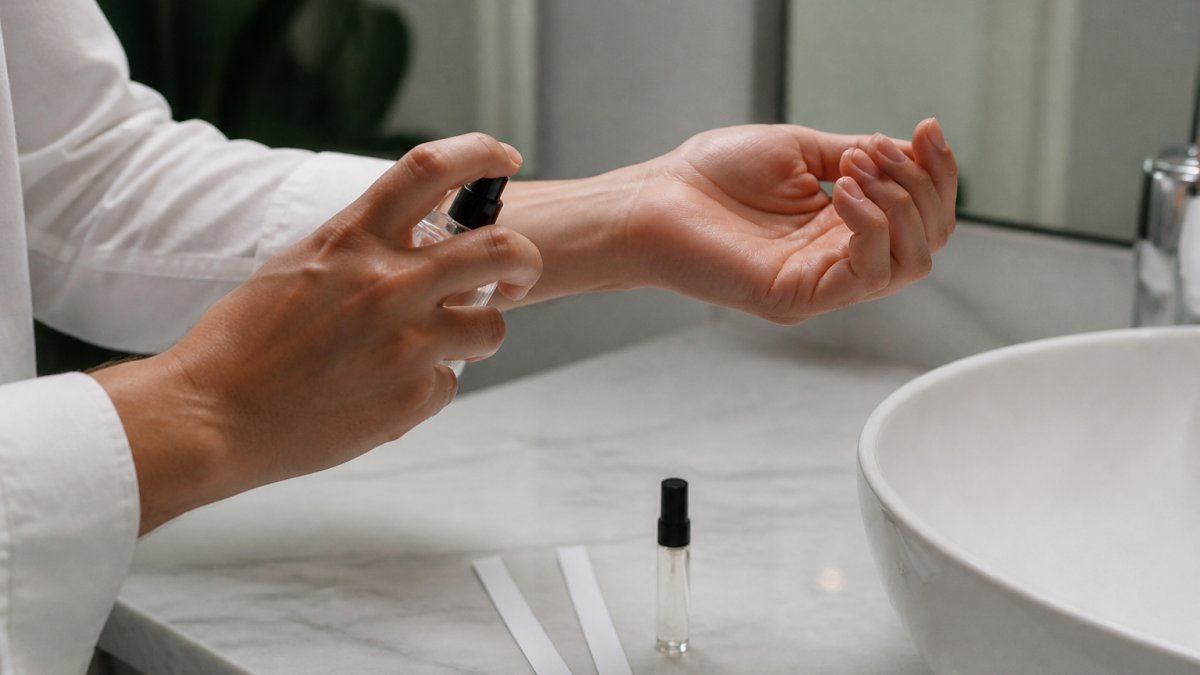
Use this sequence for every candidate. It works whether you're testing at a counter or from a sample vial at home.
Smelling one fragrance, setting it down, and smelling another an hour later is not a comparison. Your nose recalibrates, and memory for scent is weak. Test finalists on the same day, one on each arm, and check both at the same checkpoints. Keep a simple note for each: opening, heart, dry-down, and a one-word verdict. A written record beats a remembered impression every time.
A common pattern among people who end up with a signature scent is that they tested fewer fragrances, but tested each one properly. Two well-tested finalists beat ten first impressions.
Perfume longevity depends on concentration, skin chemistry, and environment, not on price. An expensive eau de parfum can fade in four hours on dry skin, while a modest eau de toilette can hold all evening on oilier skin.
What moves the needle:
Scent also shifts with the season. A heavy warm fragrance that feels right in winter can turn cloying in summer, and a fresh citrus that sings in July can vanish in the cold.
Buying fragrance online saves money but carries real risk, so treat authenticity as the first filter. Our guide on the risks of buying counterfeit fragrances online covers the warning signs in detail.
Start small. When you're ready to buy, use a list of trusted sites for authentic fragrance online rather than the cheapest search result.
A simple budget rule:
At AppleMango Fragrances, every bottle ships from within the US and arrives as new, unopened stock.
Start with scent families you already enjoy rather than the label on the bottle. Smell three or four candidates on paper strips to narrow the field, then wear no more than two on skin for a full day. Judge each one at the opening, the heart, and the dry-down before deciding. A unisex fragrance should feel like something you reach for without thinking, not a compromise between men's and women's sections.
Citrus and bergamot, herbal greens, woody sandalwood and cedar, musk, and soft amber appear across most genderless scents because they sit comfortably on a wide range of skin. Fig, black pepper, and vanilla also work well. If you want versatility, build around fresh and woody unisex fragrance notes. If you prefer warmth, lean toward musk, amber, and spice. Sample both directions before committing to a full bottle.
Give each candidate at least one full wear day, and ideally two, before buying. Apply it in the morning and note how it smells at 30 minutes, three hours, and eight hours. Skin chemistry, heat, and humidity all shift how a scent reads, so a single spray at a counter tells you very little. Testing over a weekend also shows whether it suits your usual occasions.
Eau de toilette carries a lower concentration of fragrance oil, so it opens brighter and usually fades within three to five hours. Eau de parfum runs higher, typically lasting six to eight hours with softer projection. Neither is better; they suit different habits. If you reapply midday or prefer a light daytime scent, eau de toilette works. If you want one application to carry you through a workday or evening, choose eau de parfum.
Choosing a unisex fragrance comes down to three things: knowing your scent preferences, testing on skin over real hours, and buying from a source you trust. Skip any one of those and you're guessing.
We built AppleMango Fragrances to make that last step easier, with 100% authentic niche, designer, and Middle Eastern bottles shipped fast from within the US. Explore the collection and find the scent that actually sounds like you.
{"one"=>"Select 2 or 3 items to compare", "other"=>"{{ count }} of 3 items selected"}
