
Expert Support
Available 24/7 via chat
Available 24/7 via chat

Last Updated: October 24, 2026
Quick Summary
To store designer fragrances properly, keep bottles in a dark, dry, cool spot with a steady temperature, like a closet shelf or closed cabinet away from any window. Heat, light, and moisture break down a fragrance, so avoid the bathroom and sunny dresser tops. Keep the cap on tight and the bottle upright.
The best place to store perfume is a dark, dry, cool spot with a steady temperature, like a closet shelf or closed cabinet away from any window.
This guide covers the best ways to store designer fragrances, from where to put the bottle to how to handle a half-used one. Here's the short version:
Most people get one of these wrong. The bathroom mistake is the most common.
Light and heat speed up the chemical reactions inside a perfume, changing how it smells irreversibly. Ultraviolet light is the worst offender. A bottle on a sunny dresser takes a steady UV hit, and over months the top notes fade first: citrus and light florals go flat, then the whole scent turns sharp or sour.
Heat damages from the inside, so a bottle near a radiator ages in a fraction of the time it would in a cool closet. The fix is boring and effective: a dark spot with a stable temperature.
A bathroom combines every condition that ruins perfume: heat, steam, and light. Hot showers push humidity up fast, and steam gets into the bottle every time you open the cap. Bathrooms also warm and cool all day, exactly the swing you want to avoid.
Storage habits back this up. So the fix is easy: move the bottle. A bedroom closet or a hallway cabinet beats a bathroom shelf every time.
A drawer, closet, or closed cabinet works because it blocks light and holds a steady temperature. Pick the coolest, darkest one in your home.
Here's how the common spots compare:
| Storage spot | Light | Temperature | Verdict |
|---|---|---|---|
| Bedroom closet shelf | None | Steady | Best overall |
| Closed cabinet or drawer | None | Steady | Strong choice |
| Bathroom shelf | Some | Swings with showers | Avoid |
| Windowsill or dresser top | Direct sun | Warm | Worst choice |
| Refrigerator | None | Cold, steady | Optional, with caveats |
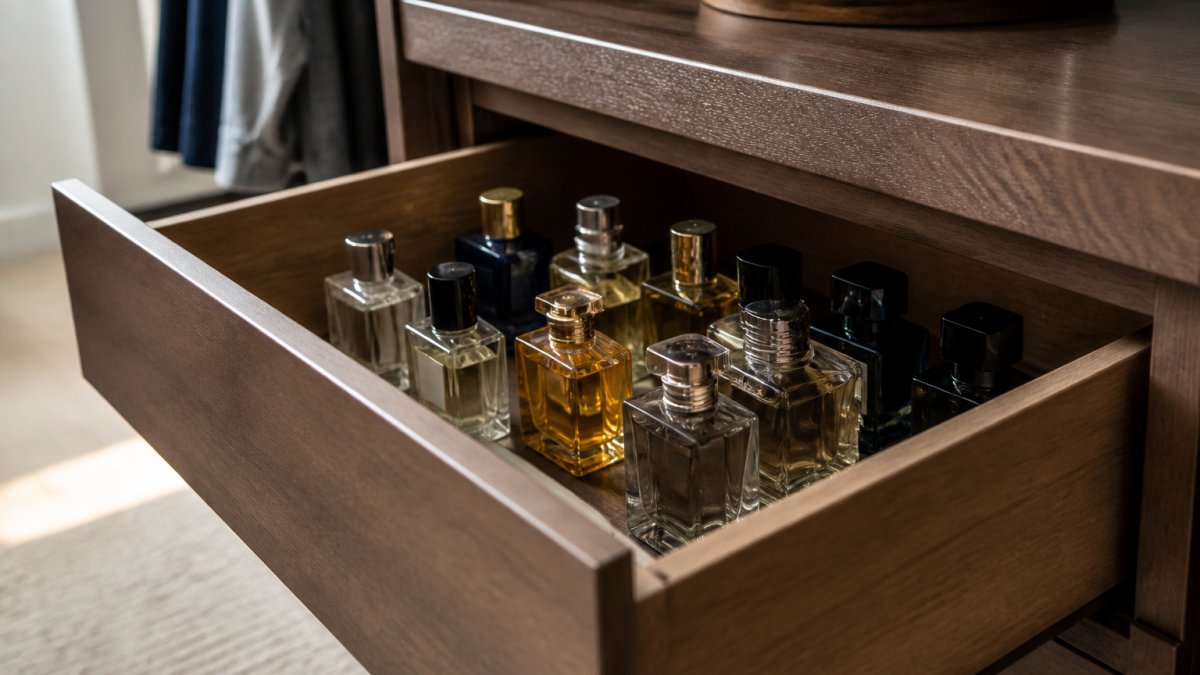
A few practical rules for whichever spot you pick:
Windows and radiators are the two worst neighbors for a perfume bottle: one pours in UV light, the other bakes the glass. Check your storage spot for both. A shelf shaded at noon may catch direct sun in the late afternoon, and a cabinet next to a radiator feels cool in summer but warm all winter.
A common mistake is storing perfume on a pretty tray near a window because it looks good. It also ages the scent fast.
Refrigeration is the most argued-about question in fragrance storage. Cold slows the reactions that degrade a fragrance, which is why a sealed bottle kept cold for years can smell fresher than one kept at room temperature.
That condensation matters: water on the neck and nozzle can seep past a cap seal, and moisture inside accelerates the breakdown of the top notes.
A fridge makes sense in a narrow set of cases:
Skip it if any of these apply:
For most people, the closet shelf wins. The fridge is a tool for a sealed bottle you plan to keep for years, not a home for the scent you reach for every morning. Simplest rule: if you would not store a good bottle of wine there, do not store perfume there either.
Designer bottles need the same treatment as any other fragrance, plus a little care for the packaging. The box and the bottle both protect the scent.
Most designer fragrances ship in a light-blocking box. Keep it: a boxed bottle survives a warm room far better than a bare one, and the box keeps the batch code and label intact for resale or gifting.
For the bottle itself:
The original packaging also matters if you collect. Boxed bottles hold value, and a clean label and tight closure signal a well-kept scent.
An opened perfume typically stays at its best for about three to five years, and many last longer when stored well. An unopened bottle holds its quality for years beyond that.
The exact number depends on the formula. Citrus-heavy scents fade faster than deep orientals, and a bottle kept in a cool closet outlasts an identical one kept in a warm bathroom.
Signs your bottle is still good:
For a deeper look at shelf life and how to stretch it, see our guide on how to store perfume to last.
Perfume has gone bad when the scent, color, or texture changes in ways you can smell and see. The changes show up in a predictable order. Watch for these signs:
One bad sign doesn't always mean the bottle is done. A slight color change with a normal scent is often fine. A sour smell is not.
If a bargain bottle smells off right away, the problem may be the source, not the storage. Our guide on the risks of buying counterfeit fragrances online explains how to spot fakes that degrade fast.
Most storage guides treat every bottle the same, but the amount of air inside changes how fast it degrades. The biggest variable is headspace: the pocket of air between the liquid and the cap. More air means more oxygen in contact with the formula, and oxygen drives oxidation, the reaction that turns a bright scent flat and sour. Storage advice should follow the bottle's status.
An unopened bottle is the easiest to protect because the seal keeps air out. Keep it boxed, upright, and in a cool, dark closet, and don't break the seal until you plan to wear it. One caveat: an unopened bottle is not immune to heat. A sealed bottle left in a hot attic or a sunny windowsill will still degrade, because heat drives reactions even without air.
Once a bottle is opened, air enters every time you spray, and the clock starts. The practical rules:
A partially used bottle is the most vulnerable because it has the most headspace. As the liquid drops, the air pocket grows and oxidation speeds up, which is why a bottle that smelled great at half-full can turn flat by the last quarter.
Practical steps for a bottle you are working through:
A partially used bottle is not doomed. It simply needs a tighter seal and a darker, cooler spot than a full one. When you are ready to restock, see where to get authentic perfume fast.
Travel is where most bottles get damaged. A suitcase in a hot car or a checked bag in a cold cargo hold is a rough ride for glass and formula. Pack smart with these steps:
For long-term storage, a sealed box in a cool closet is hard to beat. If you travel often, a refillable travel spray makes the routine easier, like King by Bharara Beauty Eau De Parfum Spray + Refillable Travel Spray 3.4 oz (Men). You can also explore TUMI travel fragrances for formats built for life on the move.
Every bottle we ship is 100% authentic and packed to survive the trip. Store it well and it will smell right for years.
A dark, dry, cool spot such as a bedroom closet, a closed cabinet, or a drawer away from windows and heat sources. Aim for a consistent temperature and 40% to 60% relative humidity, the range Goldfield & Banks recommends for perfume storage. Avoid the bathroom: 39% of people store perfume there, but steam and temperature swings speed up deterioration. Keep bottles upright and capped tightly to limit air exposure.
Refrigeration can help prolong a fragrance's lifespan, but it is not required for everyday storage. Southern Living notes that a dry, dark place like a closet or cabinet is ideal and that a refrigerator can extend shelf life, though no measured comparison exists. If you do refrigerate, use a stable, low-humidity fridge, keep the bottle sealed, and let it reach room temperature before spraying so condensation does not affect the scent.
Most opened bottles stay at their best for about 3 to 5 years when stored away from light, heat, and humidity, while unopened bottles can last longer. Citrus and light floral notes fade faster than woods, resins, and orientals. To maximize lifespan, keep the cap tight, store the bottle in its original box, and avoid repeated temperature fluctuations. Check the batch code if you want a precise production date.
Watch for a darker or cloudy color, a sour or metallic smell, a weakened projection, or visible sediment. Oxidation from air exposure is the usual cause. If the top notes smell sharp or vinegary but the base still smells correct, the fragrance is aging but may still be wearable. If the whole scent has turned, retire the bottle. Store it in a cool, dark place to slow further decline.
Most fragrance collections lose their edge to bad storage, not bad perfume. A dark closet shelf, a tight cap, and a steady temperature solve most of it. AppleMango Fragrances curates authentic niche, designer, indie, and Middle Eastern scents, ships fast across the country, and packs each order to arrive in perfect condition. Explore the collection and find a scent worth storing right.
{"one"=>"Select 2 or 3 items to compare", "other"=>"{{ count }} of 3 items selected"}
