
Expert Support
Available 24/7 via chat
Available 24/7 via chat

Last Updated: September 12, 2026
Learning how to store perfume to last comes down to controlling three enemies: heat, light, and humidity. Fragrance is a chemical composition of volatile compounds suspended in alcohol, and each of those compounds degrades at a different rate when exposed to the wrong conditions. At AppleMango Fragrances, we curate a refined selection of 100% Authentic Niche, Designer, Indie, Inspired-by, and Middle Eastern fragrances from the world's top luxury brands, making high-end perfumes accessible and convenient for every enthusiast.
Temperature swings do more damage than steady warmth. A bottle that rides from a cold bedroom to a steamy bathroom and back again forces the fragrance's chemical structure to expand and contract repeatedly, and that stress accelerates oxidation of the top notes. Industry guidance recommends holding storage between 59°F and 72°F (15°C to 22°C) to prevent scent degradation, according to Maison de L'Asie fragrance storage guidance, though some 2026 guides push the ideal range lower, into the 50-59°F band, for extended shelf life.
Steady beats cool. A closet shelf that stays at a consistent 68°F protects a fragrance better than a spot that swings between 55°F and 80°F, because it's the fluctuation, not the baseline, that drives chemical breakdown.
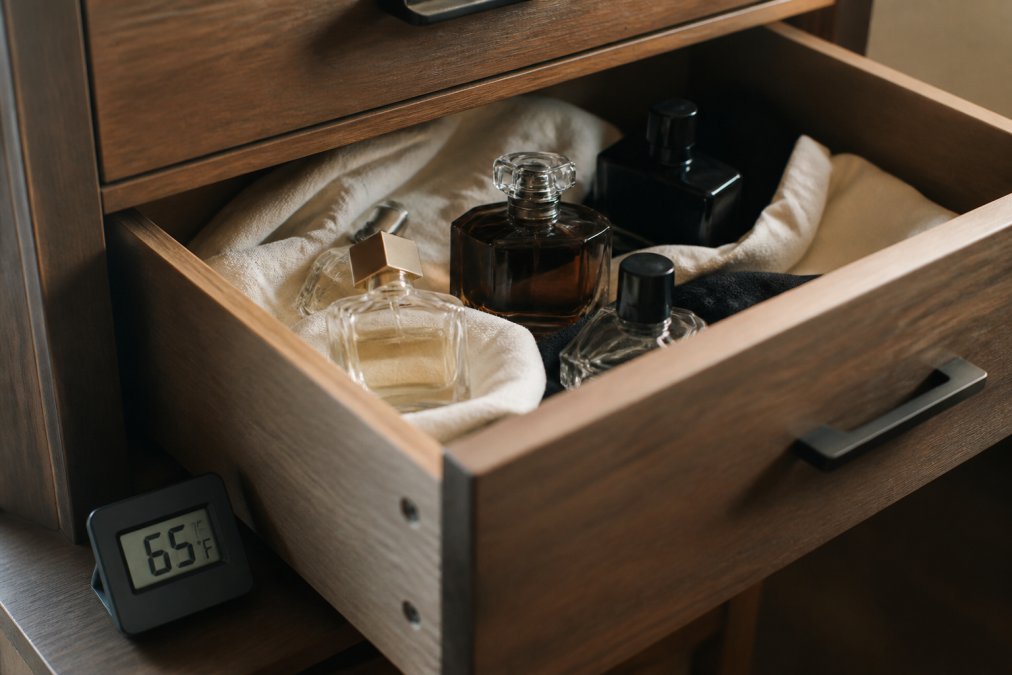
An unopened bottle stored correctly can hold its scent profile for years, often well beyond any printed date. Sealed glass keeps the alcohol base from evaporating and shields the juice from UV rays, so an unopened fragrance sitting in a cool, dark place is essentially in stasis.
Once you break the seal, the clock starts. Oxygen enters the bottle every time you spray, and oxidation begins working on the most fragile top notes first. That's why a fragrance can smell bright and sharp in year one and noticeably flatter by year three, even when nothing about the bottle has changed.
Yes, and faster than almost anywhere else in the house. The bathroom combines every condition that ruins fragrance: heat from showers, humidity levels that spike and fall daily, and often a window that lets in UV rays. Storing perfume on a bathroom counter is the most common mistake we see, and it's the one that shortens a bottle's life most dramatically.
Humidity is the underrated culprit. Steam works its way into a loosely capped bottle and dilutes the alcohol base, which throws off the balance of the fragrance notes. Even an airtight cap doesn't fully protect against a room that hits near-100% humidity twice a day.
Move the collection to a bedroom drawer or a closet shelf, and you've already solved most of the problem.
The clearest signs of expired perfume are a sharp, sour, or vinegar-like opening, a color shift toward dark amber or brown, and a scent that fades within minutes instead of hours. If your fragrance used to last all day and now disappears by lunch, the base notes have likely broken down.
A few things to check before you toss a bottle:
One caveat: some fragrances are naturally dark or heavy on base notes like oud and amber, so judge against how the bottle smelled when new, not against a universal standard.
The refrigerator question splits the industry, and both camps have a point. Cold storage does slow chemical reactions, and Real Simple's guide to extending fragrance life identifies the refrigerator as a way to maintain a stable environment and prolong a fragrance's lifespan. The catch is that a kitchen fridge is a terrible environment for perfume: it's humid, it cycles through temperature fluctuations every time the door opens, and it exposes bottles to food odors that can migrate into the juice.
Lancôme's guidance advises keeping fragrances away from cold environments altogether, favoring room-temperature dark storage instead. If you do go the refrigerated route, use a dedicated mini-fridge set to a steady temperature, keep bottles upright and tightly capped, and never store them in the door where temperatures swing hardest.
Travel is where most collections take their worst hits, and the damage is mechanical as much as thermal. A bottle tossed loose into a checked bag gets shaken against hard edges, sits in a cargo hold where temperatures can drop well below freezing at altitude and then spike on the tarmac, and rides through cabin pressure changes that push air in and out of a loosely seated sprayer. A single cracked nozzle can empty a 100ml bottle into a suitcase in transit.
The fix is a dedicated travel kit built around three principles: contain the liquid, control the temperature, and never check the bottle.
Decanting is the insider move, and it is worth doing properly. A 5ml travel atomizer carries enough for a week-long trip and keeps your full bottle at home, out of the heat and pressure cycle entirely. The mechanics matter: spray the donor bottle into the atomizer in short bursts rather than a continuous stream, which limits how much air is pulled back into the donor. Fill the atomizer no more than about three-quarters full so the collar seals cleanly, and wipe the threads before closing. Between refills, flush the atomizer with a small amount of high-proof alcohol or warm soapy water, rinse, and let it dry completely, old residue oxidizes and will contaminate the next fragrance you load.
Temperature control during transit is the part most guides skip. A carry-on stays within the cabin's conditioned range, which is close to ideal storage temperature, while a checked bag can sit on a hot tarmac for an hour before loading. If you must check a bottle, wrap it in clothing in the center of the bag rather than against an outer wall, and accept that a checked bottle is a bottle you may lose. For road trips, never leave a fragrance in a parked car, a closed vehicle in summer can reach temperatures that degrade top notes in a single afternoon, and the same bottle left on a dashboard in winter can freeze and separate.
A lit display shelf looks beautiful and quietly destroys your collection. The mechanism is photodegradation: ultraviolet light, and to a lesser degree visible blue light, supplies the energy that breaks the chemical bonds holding fragrance molecules together. Once those bonds break, the molecule is no longer the note it was, citrus top notes are usually the first casualties because their structures are the most fragile, which is why a sunlit bergamot opening can turn sharp and sour within a single summer while the base notes underneath still smell intact. Heat accelerates the same reaction, so a sunny shelf near a radiator is the worst possible combination.
That does not mean you have to hide every bottle. The practical compromise is to separate your working shelf from your archive. Keep the full collection in a dark drawer or closet, and move only the two or three you are actively wearing to the display. Rotate them back when you switch scents. That way the display stays current, your backups stay protected, and the bottles on show are the ones already in use, so any light exposure they take is on juice you are drinking down anyway.
If you want a display that is genuinely safe, build it around these choices:
For collectors building a fragrance wardrobe of five to ten scents, this rotation approach matters more than ever. More bottles mean longer gaps between wears, which means longer storage periods where conditions count, and a bottle that sits on a sunny shelf for six months between wears is aging far faster than one that lives in a drawer and comes out twice a week.
Most fragrance collections don't fail because of bad juice. They fail because of a bathroom counter, a sunny shelf, or a suitcase thrown in a hot car. Fix the storage conditions and you protect every bottle you own, whether it's a niche oud or a designer staple.
At AppleMango Fragrances, we curate a refined selection of 100% Authentic Niche, Designer, Indie, Inspired-by, and Middle Eastern fragrances from the world's top luxury brands, making high-end perfumes accessible and convenient for every enthusiast. Our commitment to quality and fast US shipping ensures a trustworthy and sophisticated experience, setting us apart in the e-commerce and retail landscape. We empower you to discover the unique scent that perfectly defines your personal style, delivered swiftly across the United States.
Explore Collection and find your next signature scent.
A cool, dark place like a dresser drawer or closet shelf is better for most perfumes. While refrigeration can provide temperature stability, industry guidelines from Lancôme advise keeping fragrances away from cold environments. The constant temperature of a dark drawer, ideally between 59°F and 72°F, prevents degradation without the risk of condensation or extreme cold that can alter the scent profile.
Yes, sunlight is one of the fastest ways to ruin perfume. UV rays break down volatile compounds and accelerate oxidation, which changes the fragrance notes and can turn a fresh scent sour. Even brief exposure through a clear bottle can cause damage over time. Always store bottles in their original packaging or inside a closed cabinet to block light completely.
Signs of expired perfume include a sharp, sour, or vinegar-like smell, a darker color than when you bought it, and a changed top note that disappears quickly. If the liquid looks cloudy or has particles, it has likely spoiled. Trust your nose: if the opening smells off or the scent fades within minutes, it is time to replace the bottle.
Keeping perfume in its original box is one of the best storage practices. The box shields the bottle from light and helps maintain a stable temperature. It also protects the atomizer from dust and accidental bumps. If you no longer have the box, store the bottle in a closed drawer or a padded pouch to achieve similar protection.
{"one"=>"Select 2 or 3 items to compare", "other"=>"{{ count }} of 3 items selected"}