
Expert Support
Available 24/7 via chat
Available 24/7 via chat

Last Updated: September 18, 2026
The global perfume market is projected to grow from $55.83 billion in 2026 to $87.17 billion by 2034, according to Fortune Business Insights market analysis. That growth is fueled by buyers who increasingly ask a sharper question: why buy designer perfume from retailers when discounters advertise the same bottle for less? This guide from AppleMango Fragrances breaks down the real economics behind designer perfume, the difference between authorized and unauthorized sellers, and how to protect yourself from counterfeits.
Fragrance concentration determines how long a scent lasts and how far it projects. An eau de toilette typically carries 5-15% perfume oil; an eau de parfum runs 15-20%. That difference is why a $70 eau de toilette and a $130 eau de parfum from the same house behave nothing alike on skin.
A designer fragrance carries costs the juice alone doesn't explain: celebrity campaigns, boutique real estate, packaging, and the deliberate scarcity that protects brand image. Industry analysis from JAAFR's study on luxury fragrance consumer behavior found that luxury houses differentiate primarily through perceived brand value and irreplaceable product quality, not price alone. The retail markup you see at a department store covers that entire apparatus.
An authorized retailer buys directly from the brand or its appointed authorized distributor, which means guaranteed product integrity, valid warranties, and recourse if something goes wrong. An unauthorized seller buys through the gray market: genuine bottles obtained outside the brand's approved chain, often diverted from other regions or bulk liquidations.
Gray market goods are typically authentic, but they arrive through uncontrolled paths. That means unknown storage conditions, possible regional reformulations, and zero manufacturer support. The fragrance may be real. The risk is what happened to it before it reached you.
Learning how to spot fake designer perfumes comes down to four checks: packaging print quality, batch code consistency, bottle construction, and scent behavior. Counterfeit products usually fail at least two of these. What most guides skip is the mechanics, how to actually run each check and what a failure tells you about the seller.
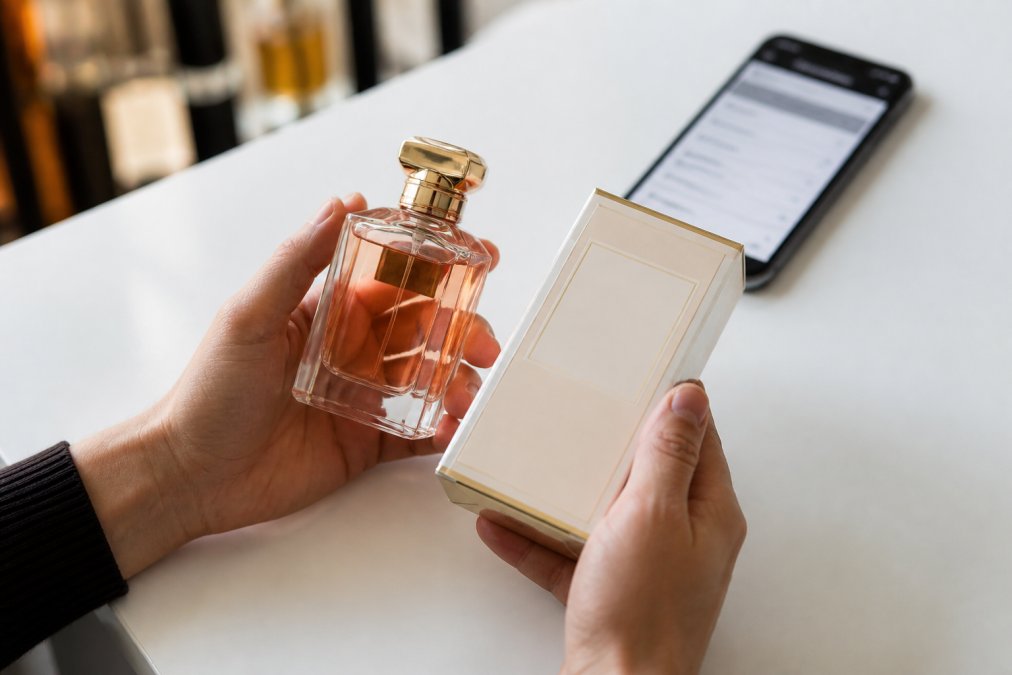
Authentic packaging uses crisp, evenly weighted fonts; fakes show blurry edges, mismatched colors, and flimsy cardstock. Look at the fine print on the bottom of the box, the ingredient list, the distributor address, the volume in fluid ounces and milliliters. Counterfeiters routinely botch the small type because it is the hardest to reproduce at scale. Check that the cellophane seal is tight and evenly folded, with no bubbling or loose corners.
A batch code is the production identifier stamped or printed on the bottle and box. It tells you when and where the fragrance was manufactured. Verifying it takes under a minute and is the single fastest authenticity test available.
Here is the practical process:
Additional checks worth running:
A genuine designer fragrance opens with its top notes, transitions through its heart, and settles into a base that lasts for hours. A counterfeit often opens sharp or alcoholic, then collapses within 30 to 60 minutes because the concentration and raw materials are wrong. Spray on skin, not paper, and check the dry-down at the two-hour mark. If the scent has vanished or turned sour, the bottle is not what it claims to be.
A single failed check is a warning. Two or more failed checks is a pattern. The most useful signal is not whether the bottle is fake, it is whether the seller can demonstrate provenance. An authorized retailer can produce a chain of custody from the brand or its appointed distributor. A gray market or marketplace seller usually cannot, which is why the batch code matters more than any visual inspection.
The risks of grey market fragrances rarely involve outright fakes. They involve scent degradation. Perfume is a chemical composition sensitive to heat, light, and oxygen, and gray market inventory often sits in warehouses with no climate control for months.
Most fragrances hold their olfactory profile for three to five years when stored away from heat and direct light. Poorly stored stock can turn in under a year. Top notes fade first, which is why a degraded bottle opens sharp or alcoholic before settling into something thin.
Store your own bottles in a cool, dark cabinet, never a bathroom. Humidity and temperature swings are the two fastest ways to shorten shelf life.
The table below summarizes how the three main seller types compare on the factors that actually affect your purchase. The paragraphs after it explain what each column means in practice, because the differences are larger than the table suggests.
| Seller Type | Pricing | Authenticity Guarantee | Returns | Consumer Protection |
|---|---|---|---|---|
| Authorized retailer | Standard retail | Yes, brand-backed | Full policy, unopened | Strong |
| Gray market discounter | 20-40% lower | Seller-claimed only | Limited or none | Weak |
| Marketplace third party | Highly variable | Unverified | Depends on seller | Minimal |
When you buy from an authorized retailer, you are buying from a business that has a contractual relationship with the brand. That relationship matters because it creates accountability. If the product is defective, misrepresented, or arrives damaged, the brand and the retailer both have an interest in resolving it. You also get the benefit of standard consumer protections that apply to retail transactions, the right to a refund or replacement when goods are not as described, and in many cases the ability to dispute a charge through your card issuer with a clear paper trail.
Return policy is where the practical difference between channels shows up fastest. A typical authorized retailer offers a defined window, often 14 to 30 days, on unopened merchandise, with a clear process for initiating the return. That window exists because the retailer can return unsold or returned stock to the brand or distributor.
For a concrete example of authorized-channel pricing, AppleMango Fragrances lists [Mon Paris Intensément(/products/mon-paris-intensement-by-ysl-eau-de-parfum-spray-3-oz-women) by YSL Eau de Parfum Spray 3 oz | applemangofragrances.com] at $133.48, with unopened items returnable within 30 days. A gray market listing for the same bottle might advertise 20-40% less, but that discount is the price of giving up the return window, the brand-backed authenticity guarantee, and any practical path to a refund if the fragrance arrives degraded.
A trustworthy perfume retailer does four things: states its sourcing, guarantees authenticity in writing, publishes a clear return policy, and ships from a known location. If a seller can't answer where the stock came from, that's your answer.
Check for these before you buy:
Price alone tells you nothing about authenticity. Sourcing transparency, a written guarantee, and a real return policy tell you everything.
Designer perfume costs more because of higher fragrance concentration, quality raw materials, and the brand's development and marketing investment. A 2026 industry report values the luxury perfume market at $27 billion, showing sustained demand. Authentic eau de parfum from a trusted retailer delivers better longevity and sillage than diluted alternatives. When you buy from an authorized source, you also get consumer protection, valid batch codes, and a return policy, which cheaper unauthorized channels rarely provide.
Unauthorized sellers often source through the gray market, meaning products may have been stored improperly, exposed to heat or light, or be near expiration. Without an authorized supply chain, you risk receiving counterfeit products, expired batches, or diluted juice. There is also no manufacturer warranty or return recourse. A 2024 study in JAAFR found that luxury brands differentiate through product quality and authenticity, which unauthorized channels cannot guarantee. Always verify the retailer's sourcing before purchasing.
Check the batch code on the box and bottle, ensuring they match and correspond to a recent production date. Inspect the packaging for crisp printing, correct fonts, and intact cellophane. The spray nozzle should be even and the scent should match the brand's olfactory profile. If the price is significantly below retail, that is a red flag. Authorized retailers provide transparency about sourcing and batch codes, so you can verify authenticity before or after purchase.
Online shopping offers convenience, wider selection, and often better prices, but you cannot smell the fragrance first. In-store testing lets you evaluate longevity and sillage on your skin. A practical approach is to test in store, then buy from a trusted online retailer that offers authentic products and a return policy. According to 2026 consumer data, 68% of shoppers prefer testing a fragrance for at least two weeks before committing, so ordering a sample or small size first can reduce blind-buy regret.
The challenge with buying designer perfume online is that the cheapest listing and the safest listing are rarely the same one. AppleMango Fragrances closes that gap by sourcing 100% authentic designer, niche, indie, and Middle Eastern fragrances, shipping fast from within the United States, and standing behind every order with a 30-day return policy on unopened items. Explore the collection and find the scent that defines your style, without gambling on provenance.
{"one"=>"Select 2 or 3 items to compare", "other"=>"{{ count }} of 3 items selected"}